Rows Houses in Great Yarmouth

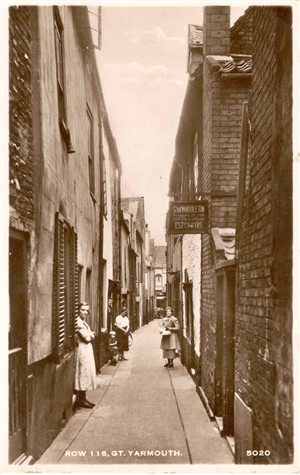
Photo:Postcard of Row 116, Great Yamouth

Postcard of Row 116, Great Yamouth

Great Yarmouth Museums
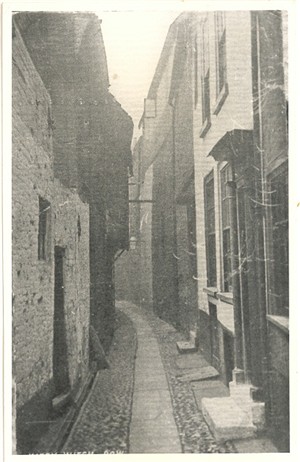
Photo: Illustrative image for the 'Rows Houses in Great Yarmouth' page
Photo:Kittiwitches Row

Kittiwitches Row

Great Yarmouth Museums

Photographs and information about Great Yarmouth Rows
By Richard Dade

Nobody knows for certain how or why the Rows originated as a distinctive town layout system, perhaps unique to Great Yarmouth. They appear to go back to the 11th century, when the sandbanks at the mouth on the River Yare were first settled as a recognisable community of fishermen.

The Rows were identified by traditional names, though they were not numbered until 1804, when there were 145. Row names were often taken from notable residents, such as Bayley's Row (no. 97) from Joseph Bayley, a surgeon, or Harnmer's Row (no. 80) from Robert Harnmer, bailiff, or Peacock's Row (no. 142) from a public house of that name. Inevitably, names tended to change, leading to some confusion.

Perhaps the best known was Kittiwitches Row (no. 95) which was also the narrowest, being just 30 ins. (0.9 m.) at its western end. This may originally have gained its name from Kit Witchingham, a 17th century baker who lived here, though there are many other theories about witches and strange happenings in this row. A line of jettied Tudor houses overhung the south side, which, combined with its extreme narrowness, made it always a gloomy place.

So what was a Row like, and what were the conditions in these homes? Almost by definition, the Rows were extremely narrow, mostly too narrow for a normal horse cart to pass down. (The solution to this was the 'Trollcart', which was specially constructed to be narrow enough to pass through most of the rows, and after which the 'Trollcart' Public House has been named.) Most Rows were paved with beach pebbles, which made them hard to walk on. A few were paved with flagstones and carts were banned from these to make them safer for pedestrians.

Moves to clear the worst of the Rows began in 1936, but had made little progress by the outbreak of war in 1939. In the end it was German bombing raids, notably in 1941, which did much of the work, destroying or damaging beyond repair large areas of the old town. In the 1950s, local planners continued where the Luftwaffe had left off, and most of the remaining buildings were cleared to make way for new housing and shopping developments. The destruction of the Rows - however desirable on health grounds - met with some resistance at the time from many residents.

This page was added by Richard Dade on 26/01/2007.

Comments about this page

my grandmother owned a house in one of the rows which the council placed a compulsory order on just before the 2nd world war. I still have all the correspondence relating to the purchase.
I would be happy to show it to anyone with an interest

By barbara taylor
On 11/01/2010

I sent an incorrect email address so I am repeating my comment
I have documents relating to the compulsory purchase of a property situated in the rows, belonging to my late grandmother.(dated just before the 2nd world war)
I am happy to show them to anyone with an interest

By Barbara Taylor
On 11/01/2010

Thank you for the picture of 116 above - my great, great,great grandparents lived there.It was good to see where they lived.

By chris setchell
On 10/08/2010

my mother was born in row 116 no 10 in1 916 its lovely to see is it still there ? I will look

By P.DONAGHY
On 27/08/2010

My mother was one of 10 chrildren brought up in row 22, Barnes Row. She has nothing but fond memories of living there, but it must have been a terrible struggle for my grandparents, God bless them. In 1939 they were rehoused in Newtown where I grew up.

By sandra smith
On 03/09/2010

it is so good to see a picture of the Rows. My great grandparents and my grandmother lived in no 39 the Rows its great to see the sort of place she lived in as a girl.

By susan cook
On 29/09/2010

My father lived in one of the Rows as a child with his parents sister and brother. I think it was Row 13 which I have been told is near the Market Place. Any information  - I would be grateful.

By ann rhodes nee yerrell
On 25/10/2010

My Great Grandmother (Florence Balls nee Hough, from Sheffield) and Grandfather Edgar Balls are listed as living at No 4, Row 119 in the 1911 census. I think the entrance of Row 119 still exists.

David Ball

By David Ball
On 25/10/2010

I was born 29.07.1925 in Row 3 at my grandfathers house no 17, and started at Rampart Road School in 1930.

By william.r.v.nicholls
On 06/01/2011

My grandfather and then my father owned the selbourne house/hotel, which I believe was beside Row 65 or 56.. Fond memories.

By victor
On 06/01/2011

I live in Australia and would like to know more about the Rows (my Hawkins family came from Row 123 in the 1830s). Can anyone suggest where can I find more information, either online or in printed form? Thanks, Cathy.

By Cathy Hawkins
On 06/01/2011

I was born at no17 Row 3 on the 29 July 1925, which was my grandmother's house.

By w.r.v.nicholls
On 06/01/2011

Ii gave the wrong no. of the rows my grandmother lived in with my great grandmother and greatgrandfatherand also her brother I said they lived in 39 the rows but they lived in 139 the rows their names were Alice and William Calthorpe my great grandperents, their daughter Laura (my gradmother)and there son William, any information would be greatly recieved.

By Susan Cook
On 28/01/2011

My grandfather, then my father owned the Selbourne House, which stood on what is now the car park at the back of Palmers. (This was) compulsery purchased around 1969 by the council then knocked down. The Selbourne House was a hotel with bar and food being served. It didn`t have a good reputation as it was used by women of the night. Having said that the bar was quite busy and a lot of sailors from around the globe used it for a good drinking session. Lots of local people still remember the hotel, some with good memories and laugh about what went on behind closed doors after hours, as I do.

By frank
On 19/04/2011

My husband's maternal Hackney and Linaker families lived in various places in Gt. Yarmouth, including Rows 45 and 137, North Quay and Cobholm Island. Would love to connect with any that are still living in the area and to know more of the living conditions there in the late 1800s.

By Pat Whitelaw
On 19/04/2011

According to my 2 x Gt Grandfathers marriage certificate, he was living on Row 96 at the time of his marriage 1852. Would love to know if there is a way to find out who he was living with around this time as he isn't listed on any census papers and there is a blank space on his marriage certificate for fathers name. Any feedback would be great. Regards.

By Jacquie Taylor
On 06/07/2011

I was interested in the entry by David Ball, re Row 119. I was born in Row119 No. 16 in 1936. The entrance to the row still exists but only a small section of the row itself is still there. The entrance is in Kings Street opposite St. Georges Church. See attached photographs. My grandfather Arthur Albert Swallow lived in Row 121 No.3 and Row 32 No.3. He died in Row 50 No, 4 Raymond Brown

By Raymond Brown
On 05/08/2011

I only recently discovered the existence of the ROWS on a short break a couple of weeks ago. The Time and Tide museum is a must for authentic information. An ABSOLUTE must is a small art museum opposite Time and Tide in the old town walls. This is a small display of the resident artist's work, behind which is the most fantastic museum and workshops built inside an old herring smoke house. Ernie, the artist, potter and proprietor is a delightful character and mine of information.Shipwreck timbers, up to 500 years old, all retrieved from the sea bed play an important role in the fabric of this fascinating place. This really must not be missed!!

By Mike Bradbury
On 05/08/2011

Add a comment about this page